
How to Build a Content Gap Analyzer AI Agent using Claude Code
Learn how a content gap analyzer Claude Subagent uncovers strategic content opportunities to boost your content planning and growth. Learn the proven AI automation system.

Two months back I stared at my content calendar with no idea what to write next for GenAI Unplugged.
I had topics. I had ideas. I always have them. But which ones MATTERED? Which had demand? Which were competitors ignoring? Which would actually move the needle?
I was planning content based on gut feeling.
“This feels like a good topic.”
“I haven’t written about that in a while.”
“Let me check what competitors posted recently.”
Three hours later, I’d scrolled through competitor blogs, searched Google for trending topics, and checked Reddit for questions people ask. Result?
A vague sense that “MCP servers are hot right now” and no clear plan. Ended up creating a full MCP free course over several weeks.
This is content strategy without data.
So I built a Content Gap Analyzer. The most strategic agent in my entire suite of AI Agents.
It audits my coverage, compares against competitors, identifies trending topics, and scores opportunities by demand + fit + differentiation potential.
This is Article 6 in the PubFlow OS Agents series, the finale. Over the past 5 articles, we’ve built a complete content automation system, one agent at a time. Each article includes my actual build log: timestamps, decisions, and what really happened. This article completes the system with the most strategic agent of all.
How do I build a content gap analyzer AI agent?
Create a Claude Code subagent that combines Perplexity trend research with Firecrawl competitor scraping. The agent audits your existing content, identifies what’s missing, and delivers prioritized opportunities with opportunity scores. Not just ideas, but strategic recommendations.
By the end of this article, you’ll build a Content Gap Analyzer that answers the hardest content question: “What should I write about next?”
What Does the Content Gap Analyzer Actually Do?
Here’s what using the agent looks like.
Mode 1: Monthly Landscape Analysis
First Monday of each month, I run:
/gap-analysis monthly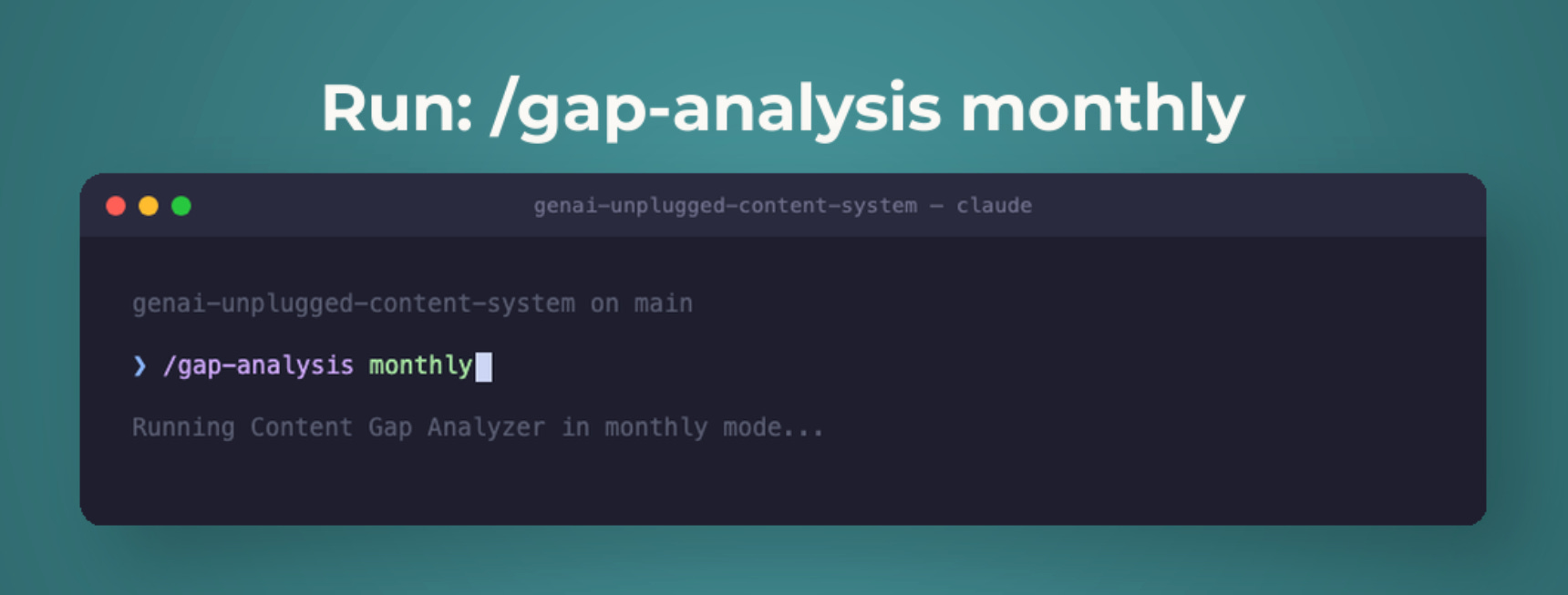
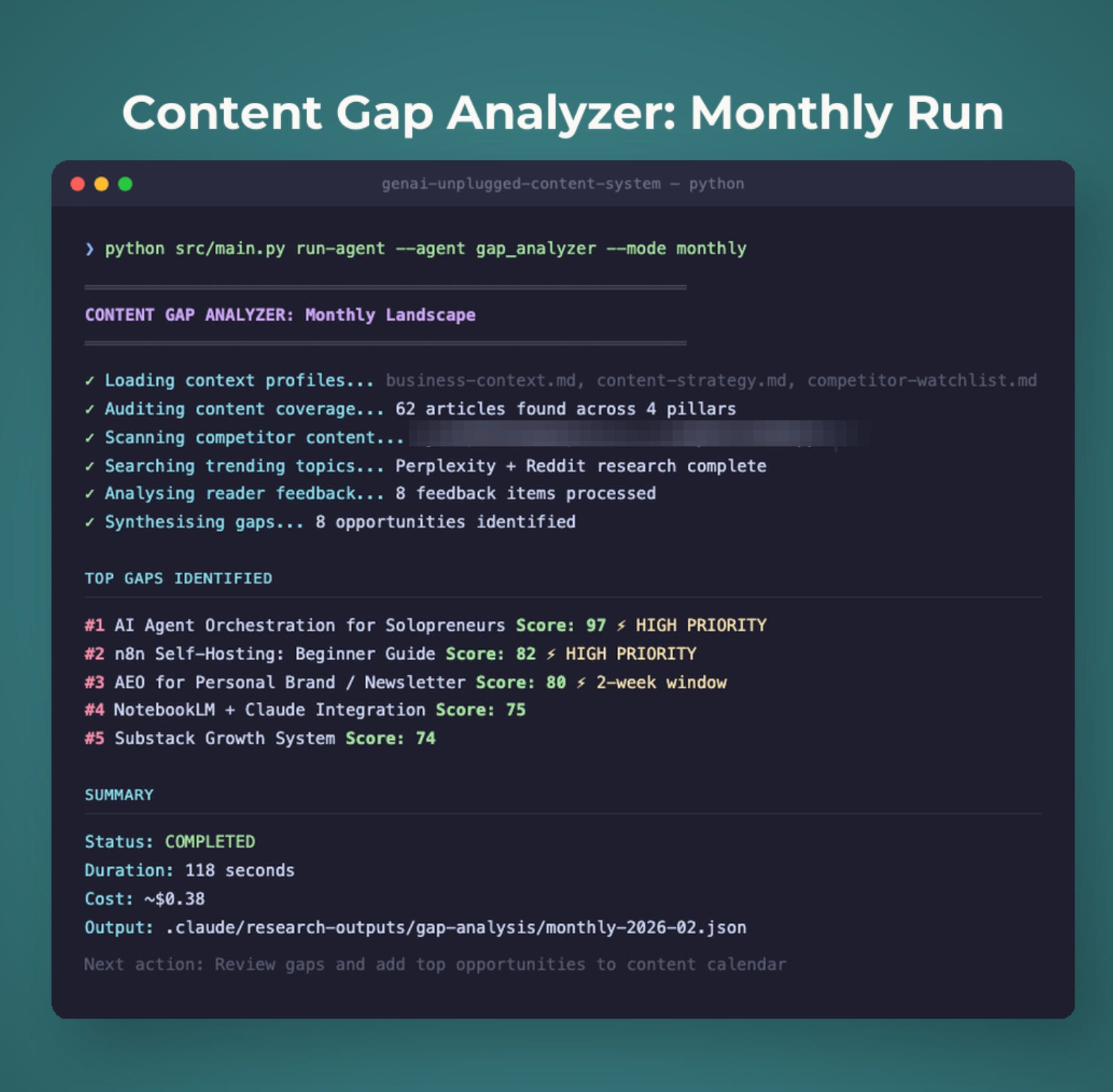
94 seconds later, I have a comprehensive content opportunity report:
Our Coverage Summary: 45 articles across 4 pillars
Gaps Identified: 12 high-opportunity topics we haven’t covered
Trending Topics: 5 emerging topics to watch
Declining Topics: 3 topics losing steam
Series Opportunities: 2 potential multi-article series
Here is a sample output from a recent run…
Mode 2: Series or Pillar-Specific Analysis
When I want to go deep on a specific area like a particular series or content pillar, I run:
/gap-analysis pillar "From Demo to Dependable"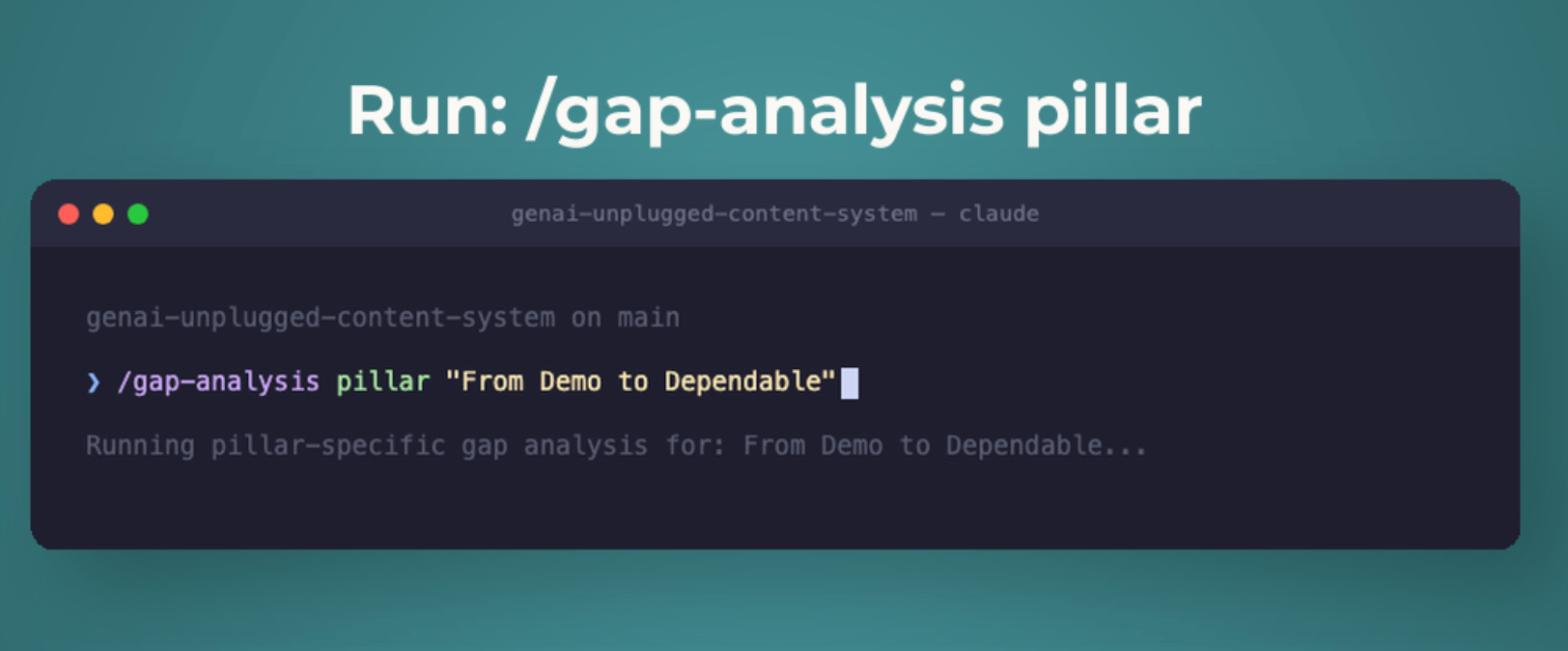
137 seconds later, I have a pillar deep-dive:
Current Coverage: 10 articles covering 7 themes
Subtopics Missing: 7 major gaps identified
Series Opportunity: Season 2 recommended (7 articles)
Priority Actions: Draft testing article first (highest demand)
Here’s what the actual output looked like for my “From Demo to Dependable” series for a recent run:
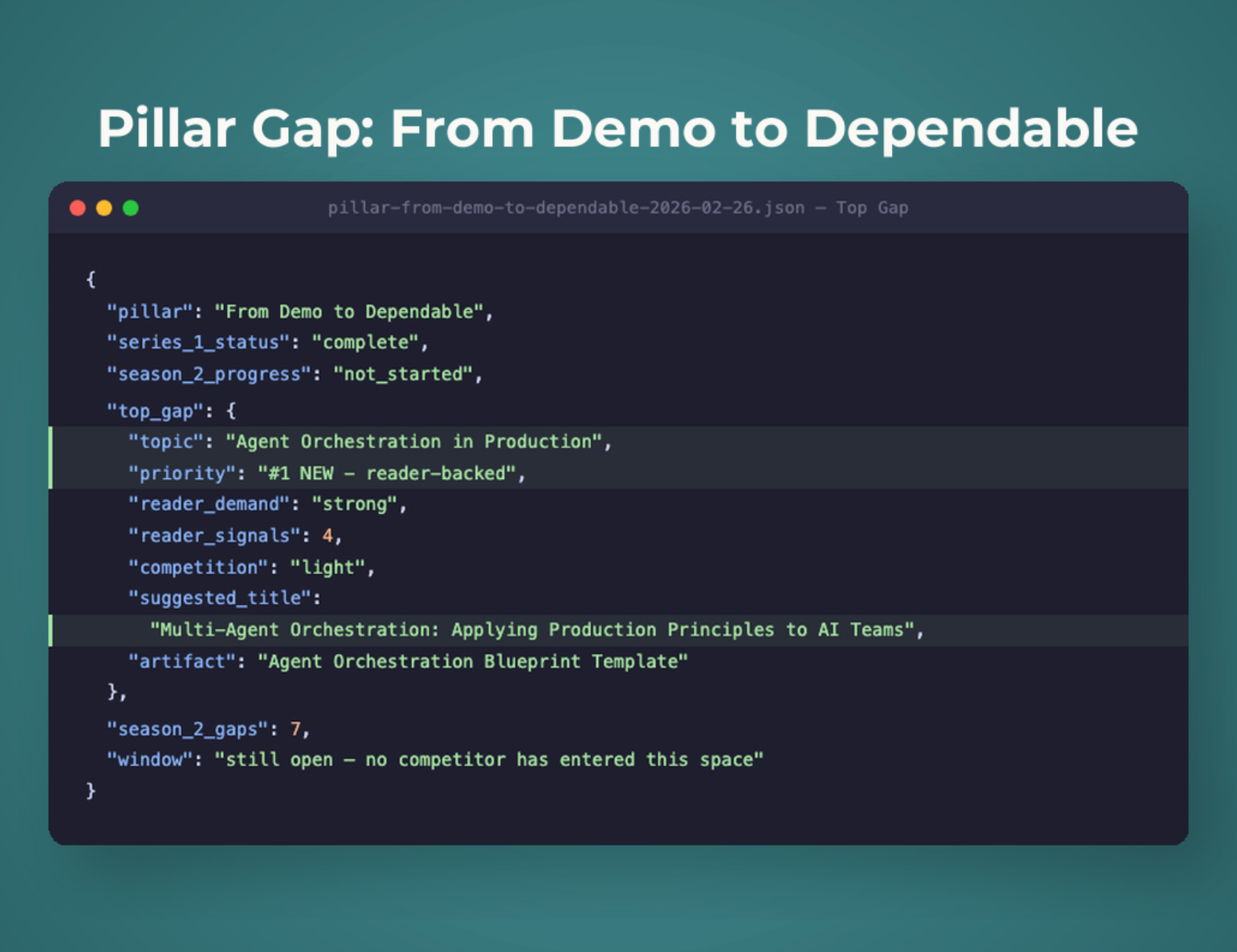
The agent didn’t just find gaps, it found an entire SERIES. Seven articles with clear demand, minimal competition, and natural fit with my existing content.
This is content strategy at scale.
Mode 3: Trend Analysis
When something new emerges, I run:
/gap-analysis trend "MCP servers"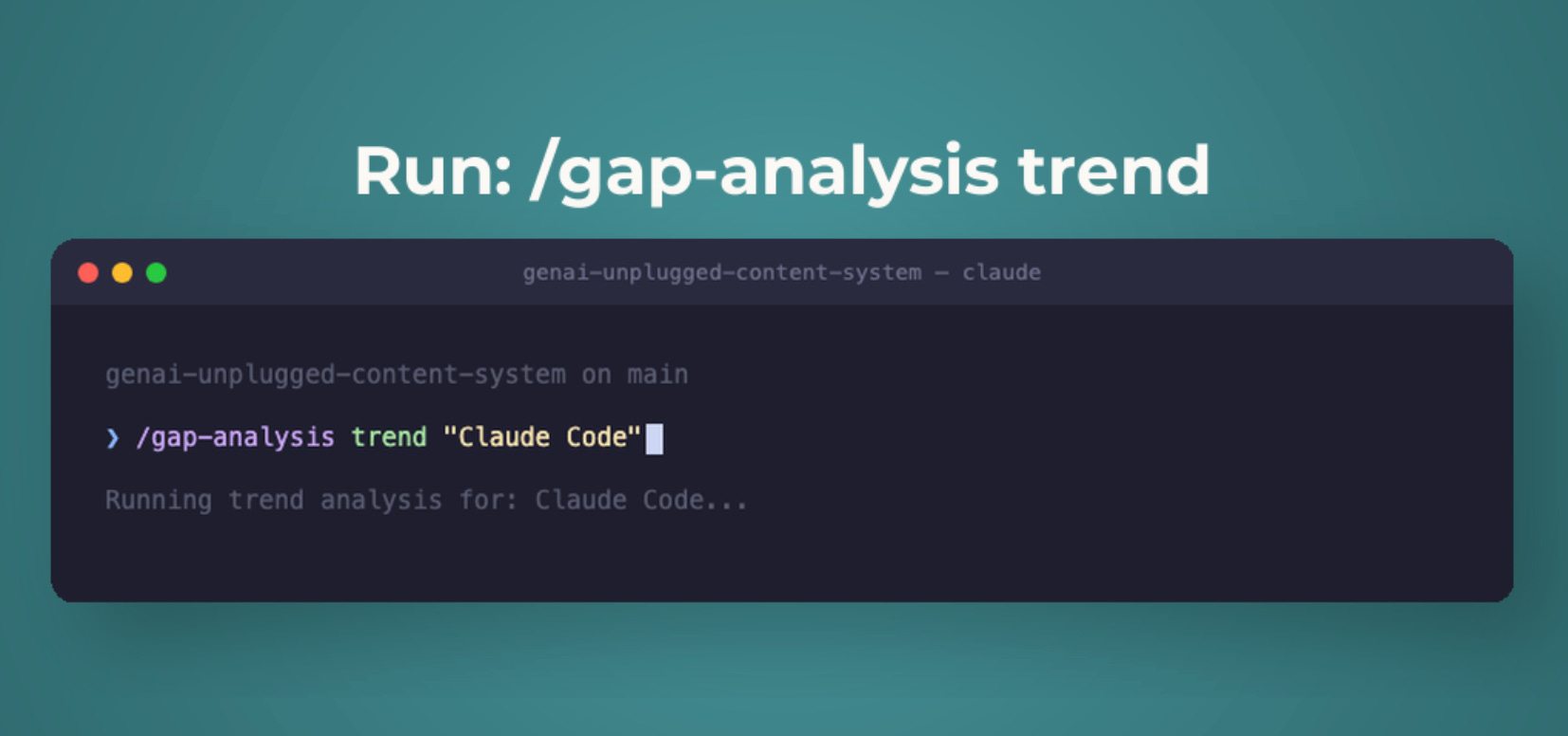
179 seconds later:
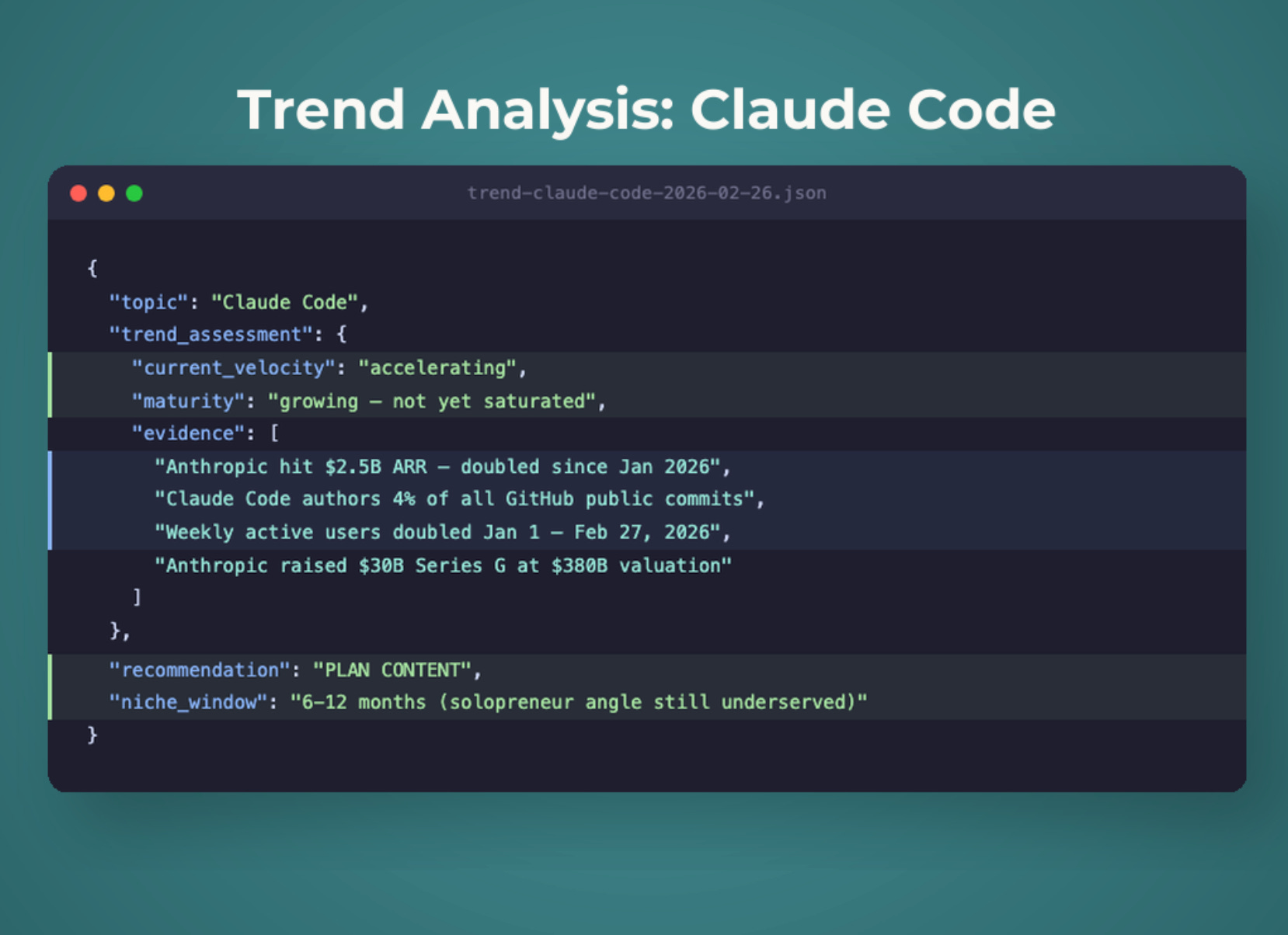
The agent tells me exactly when to jump on a trend and when to let it pass.
How Does This Content Gap Analyzer AI Agent Fit Your Workflow?
Here’s how the Content Gap Analyzer fits my content planning:
Monthly Planning:
First Monday of Month:
1. Run /gap-analysis monthly
2. Review top 5 gaps
3. Pick 2-3 for this month's content calendar
4. Schedule topics with /slot-dates (that's part of my contentOS commands) but you can manually plan.
Series Planning:
When series opportunities appear:
1. Review suggested structure
2. Create series config in config/series/
3. Add articles to Notion calendar
4. Run /research for each article
Trend Monitoring:
When something new emerges:
1. Run /gap-analysis trend "[topic]"
2. If "cover_immediately" → add to this week
3. If "monitor" → check again next month
4. If "ignore" → skip it
The Gap Analyzer drives WHAT you write. Everything else supports HOW you write it.
Why This Agent Is the Series Finale
Over the past 5 articles, we’ve built:
Research Agents Foundation - Foundations of these five Claude Code Subagents
Content Researcher - Deep topic research before writing
SEO/AEO Researcher - Real keyword data + AI citation optimization
Competitive Analyzer - Monitor competitors, identify gaps
Technical Verifier - Verify accuracy before publishing content
The Content Gap Analyzer is the most strategic agent because it answers the FIRST question: “What should I write about?”
Everything else flows from that decision.
You research AFTER you’ve identified a topic.
You analyze SEO AFTER you’ve chosen the angle.
You verify AFTER you’ve written.
Gap analysis comes first. It’s the strategic layer that makes everything else more valuable.
This is why it’s the finale because it completes the system. I know some may say why wasn’t it first then but then there is no good climax 😀
What Results Can You Expect from This Agent?
Here is my cost and effort breakdown if I continued to use the same tooling for GenAI Unplugged that I used to use for my travel blog.
Before this agent:
3+ hours per month on content planning
Topics chosen by gut feeling
No systematic gap identification
Miss emerging trends
Invest in declining topics
After this agent:
10 minutes per month for strategic planning
Topics chosen by data
Prioritized opportunity scores
Trend alerts with timing
Declining topic warnings
ROI Calculation:
Previous time: 3 hours/month × 12 months = 36 hours/year
New time: 10 minutes/month × 12 months = 2 hours/year
Time saved: 34 hours/year
Cost: $1-$2/month
The math is trivial. But the real value isn’t time savings, it’s the quality of decisions. Every article starts with validated demand, not gut feeling. The Content Gap Analyzer prevents wasted effort before it happens.
What Does Real Monthly Output Look Like?
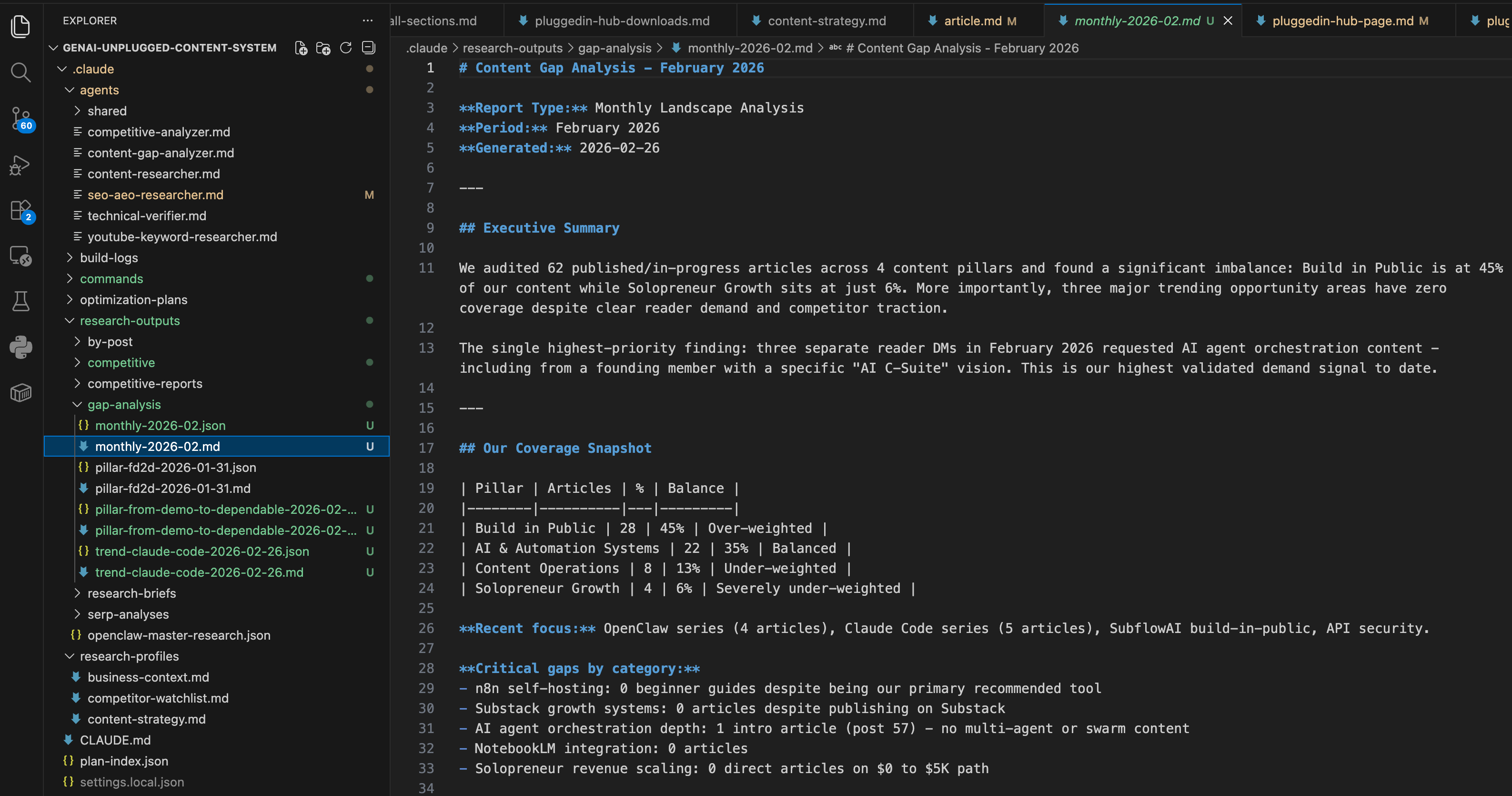
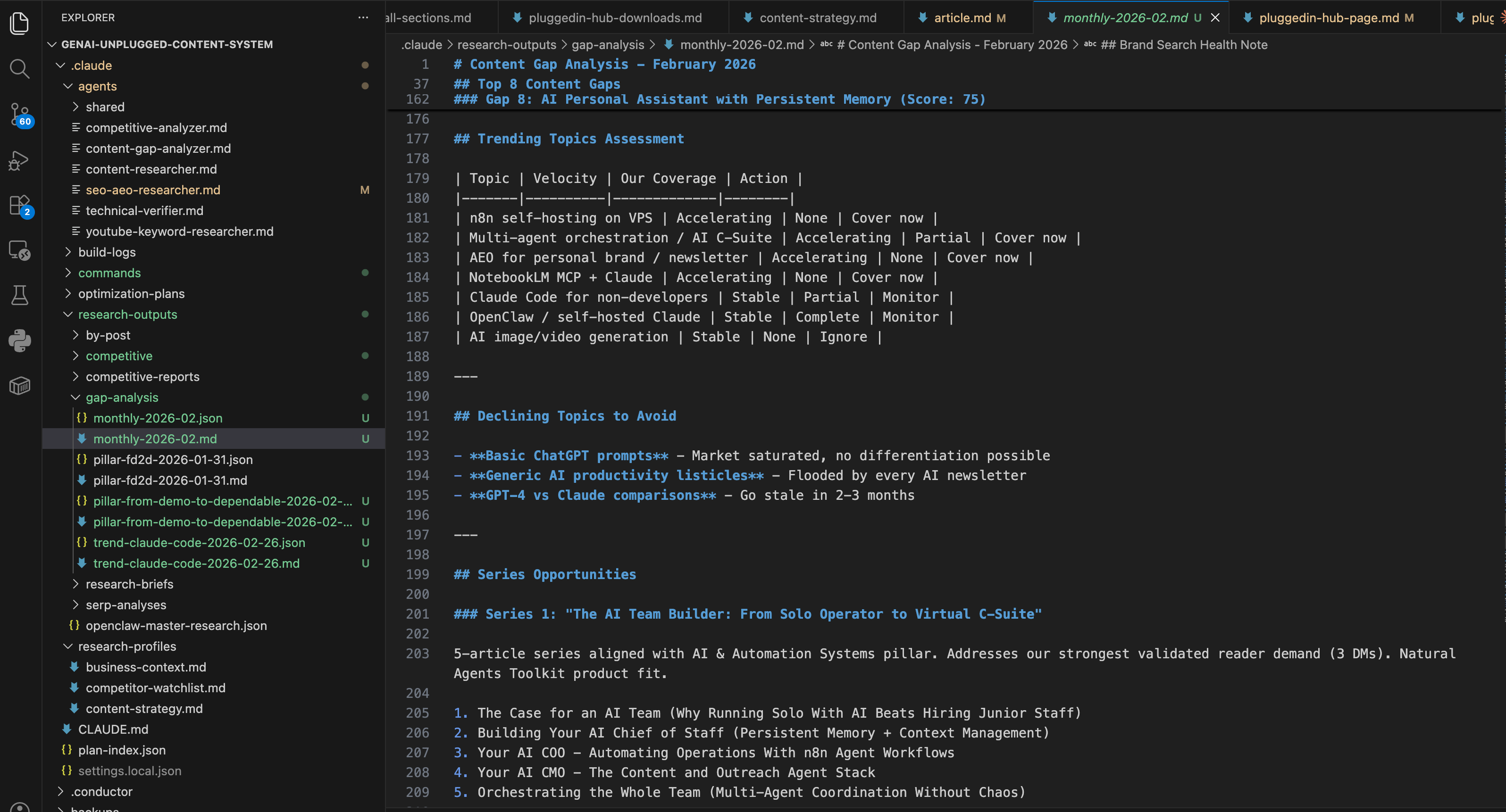
Here’s a sample from an actual monthly landscape report:
Executive Summary
Trending & Declining Topics Assessment
Series Opportunity
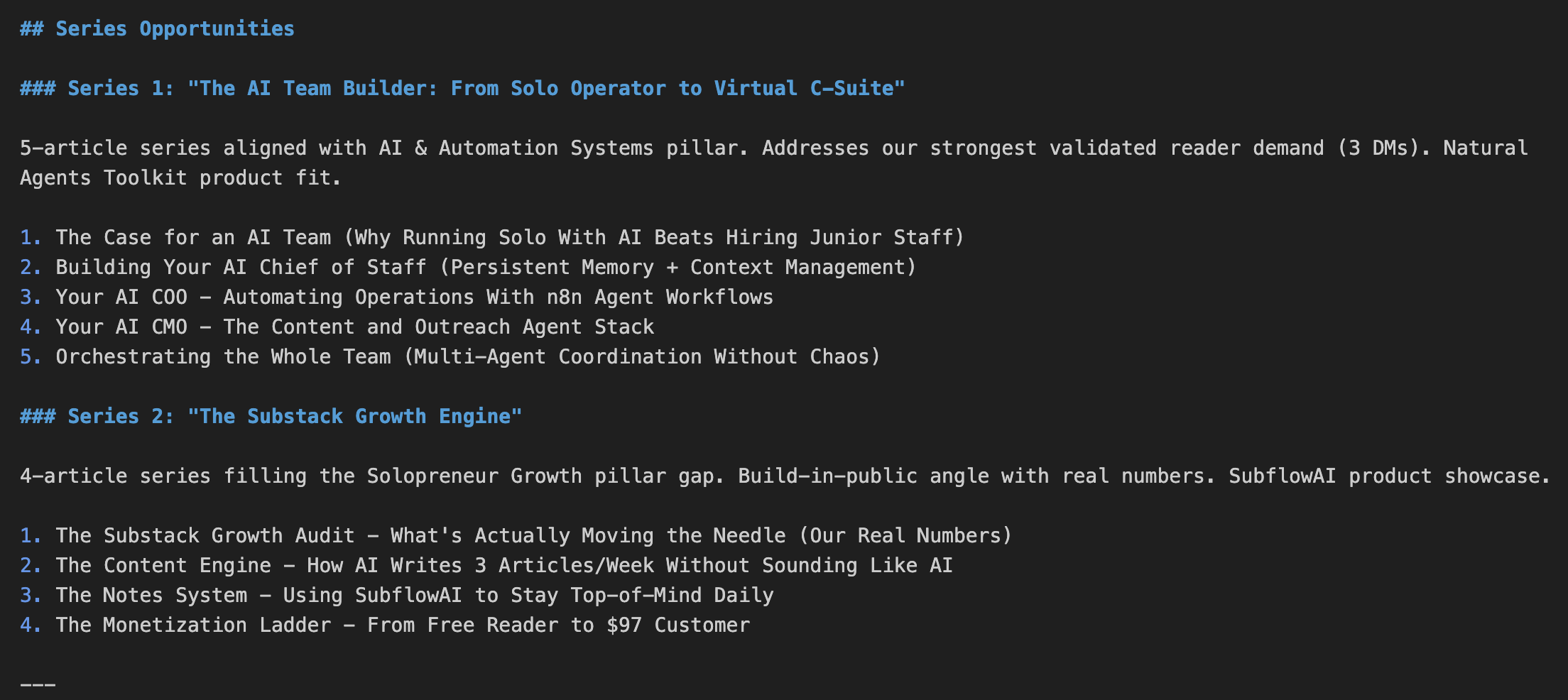
The agent found not just topics, but an entire content strategy direction.
What Foundation Do You Need Before Building This Claude AI Agent?
RULE: Every agent you build follows the same foundation we set up in Article
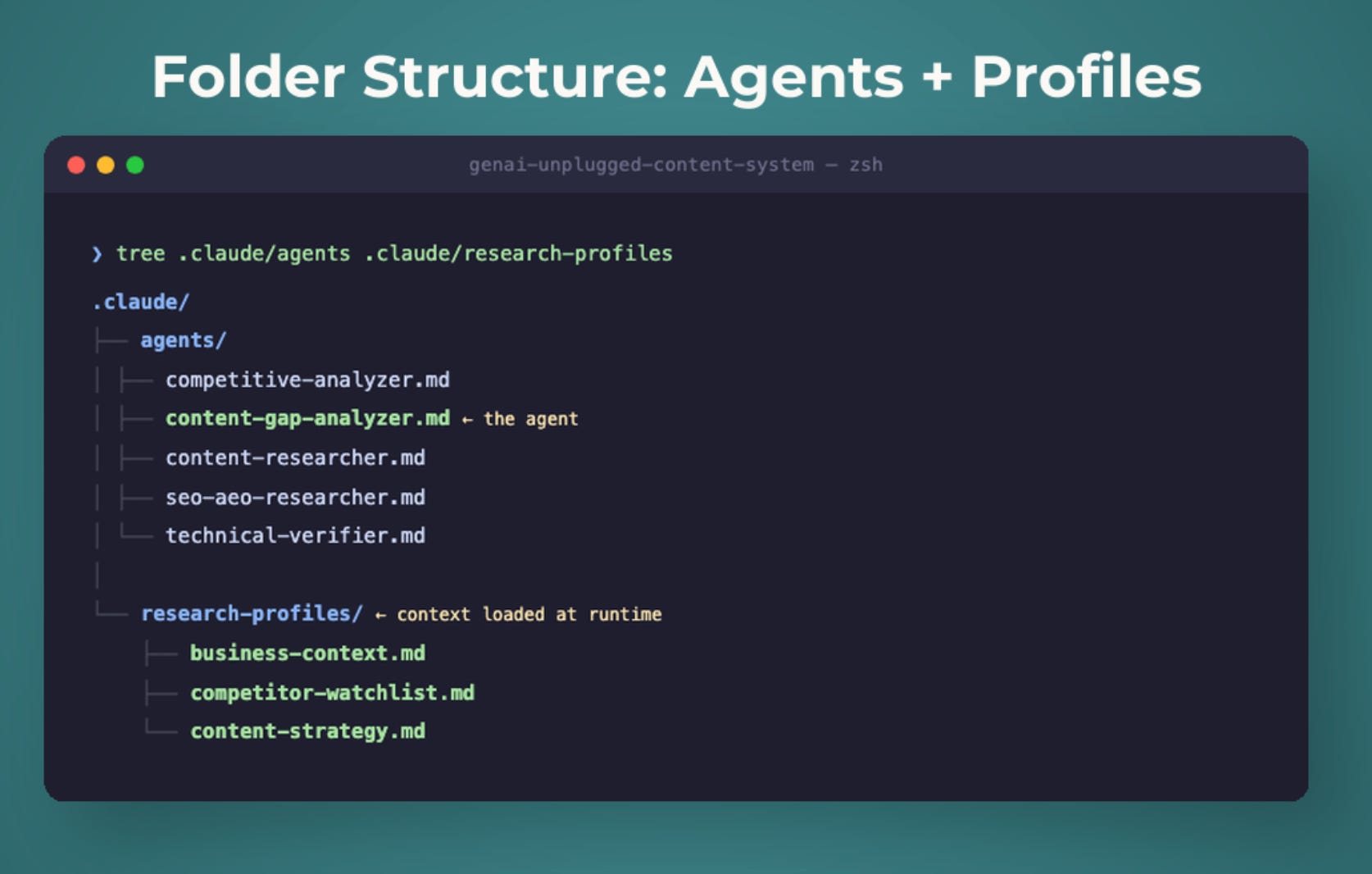
In the first article of this series, we set up the Claude Subagents Building Starter Kit. This includes:
Claude Code CLI installed (
curl -fsSL https://claude.ai/install.sh | bash)MCP servers configured (Perplexity, Firecrawl)
Folder structure for agents (
.claude/agents/)API keys for Perplexity and Firecrawl
Research profile files (business context, content strategy)
Here’s the 5-minute catch-up:
Quick Checklist:
Do you have Claude Code CLI? (Check:
claude --version)Do you have free Perplexity API key? (Get it: perplexity.ai/api)
Do you have free Firecrawl API key? (Get it: firecrawl.dev)
Are MCP servers configured in Claude Code? (Check settings)
Are your research profile files set up?
If you followed Articles 1-5 (just below), you’re ready to build. If you’re joining at the finale, head to Article 1 for foundation setup.


Additional Requirement:
Content strategy file with your pillars (essential for meaningful gap analysis)
Competitor watchlist file (created in Article 4)
How Do You Create a Content Strategy?
The Content Gap Analyzer AI Agent is only as good as the strategy it reads. Feed it vague pillars, you get vague gaps. Feed it specific ones, you get actionable opportunities.
Your content strategy file answers three questions:
What pillars do you publish under? Not “AI stuff” - specific verticals. “AI Automation Blueprints” is a pillar. “n8n tutorials” is not (that’s a topic within a pillar).
What does your voice sound like? Not brand guidelines - the practical version. What words do you actually use? What words make you cringe? The agents use this to filter recommendations through your lens.
What makes you different? The agent needs to know your positioning to recommend gaps that fit YOU, not generic trending topics that fit everyone.
Think of it this way:
Without a content strategy file, the Gap Analyzer gives you “trending AI topics.” With one, it gives you “topics YOUR audience wants that YOUR competitors aren’t covering in YOUR voice.”
That’s the difference between a research tool and a strategic advisor.
Here’s how to fill it out:
Content Pillars - List 3-4 pillars. For each one, be specific about focus, content types, and example topics. Don’t write what you WANT to cover. Write what you ACTUALLY cover. The agent audits your existing articles against these pillars.
Brand Voice - Write 3-5 principles that describe how you communicate. Not aspirational (”we’re innovative”) - practical (”We use specific numbers instead of vague claims”). Include words you use and words you avoid.
Content Positioning - What makes your content different from competitors covering the same topics? This is the filter. When the agent finds a gap, it checks whether YOUR angle would actually be different.
Three to five bullet points per section is enough. You’re not writing a brand book, you’re giving the agent enough context to think like you.
Create .claude/research-profiles/content-strategy.md:
 # Content Strategy Profile

> **Purpose**: This file defines content pillars, voice guidelines, and positioning for research agents.
>
> **Instructions**: Fill in your content pillars and brand voice. The agents use this to ensure research aligns with your content strategy.

---

## Content Pillars

### Pillar 1: [YOUR PILLAR NAME]
**Focus**: [What this pillar is about]
**Content Types**: [e.g., Tutorials, Case studies, Behind-the-scenes]
**Example Topics**: [3-5 specific topic examples]

### Pillar 2: [YOUR PILLAR NAME]
**Focus**: [What this pillar is about]
**Content Types**: [e.g., Guides, Templates, Reviews]
**Example Topics**: [3-5 specific topic examples]

### Pillar 3: [YOUR PILLAR NAME]
**Focus**: [What this pillar is about]
**Content Types**: [e.g., Strategies, Workflows, Case studies]
**Example Topics**: [3-5 specific topic examples]


---

## Brand Voice Summary

### Core Principles
1. **[PRINCIPLE 1]** - [What it means in practice]
2. **[PRINCIPLE 2]** - [What it means in practice]
3. **[PRINCIPLE 3]** - [What it means in practice]
4. **[PRINCIPLE 4]** - [What it means in practice]
5. **[PRINCIPLE 5]** - [What it means in practice]

### Tone by Avatar
**Avatar A ([PRIMARY])**: [Describe the tone - formal/casual, pace, style]
**Avatar B ([SECONDARY])**: [Describe the tone - formal/casual, pace, style]

---

## Language Patterns

### Words We Use
**Problem language**: [Words that describe problems you solve]

**Solution language**: [Words that describe your approach]

**Outcome language**: [Words that describe results you deliver]

### Words We Avoid
**Marketing jargon**: [Overused phrases you never use]

**Fear-based**: [Fear-mongering phrases you avoid]

**Vague claims**: [Empty phrases that lack specificity]

---

## Content Positioning

### What Makes Us Different
1. [Unique angle 1]
2. [Unique angle 2]
3. [Unique angle 3]

### Authority Signals
- [Credential or experience 1]
- [Credential or experience 2]
- [Credential or experience 3]

---

## Publishing Schedule

| Day | Content Type | Platform |
|-----|--------------|----------|
| [Day] | [Type] | [Platform] |
| [Day] | [Type] | [Platform] |
| [Day] | [Type] | [Platform] |

---

## Internal Links Strategy

**Link to**:
- [Foundational content pieces that every reader should see]
- [Products/services you want to promote]

**Link from**:
- [Types of content that naturally lead to other content]

---

*Last Updated: [DATE]*
*Update this file whenever your content strategy or brand voice evolves.*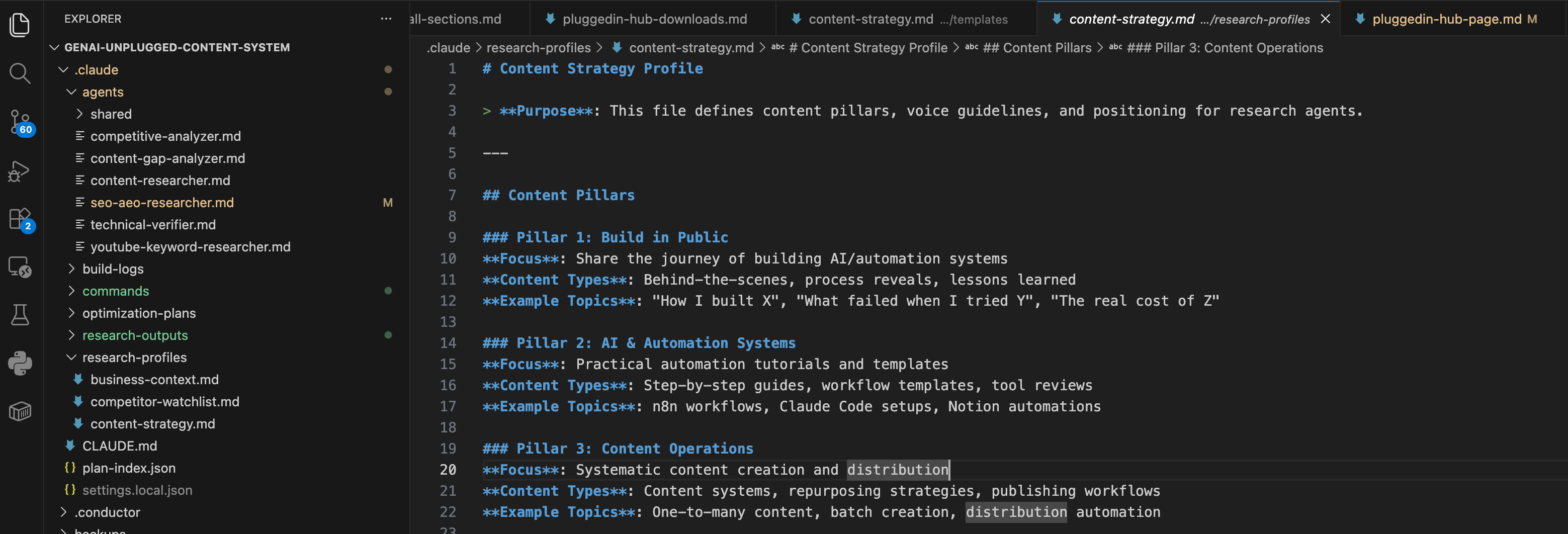
What Happens Next?
You’ve built agents that research topics, analyze keywords, monitor competitors, and verify accuracy. Those agents help you create and protect content.
But they all assume you already know WHAT to write. This one answers that question.
Here’s what you’re unlocking:
Full Business Context → The agent needs to understand your pillars, your competitors, your positioning. Without that context, gap analysis is generic “trending topics” lists. With context, it’s personalized strategic intelligence.
Ongoing Value → This isn’t one-time research. Monthly landscape reports. Pillar deep-dives. Trend monitoring. The value compounds over time as you build a pattern of strategic content decisions.
High-Stakes Output → Content calendar decisions affect months of work. A wrong direction means wasted effort. The Gap Analyzer helps you bet on the right topics.
Synthesis of Everything → This agent uses insights from competitive analysis, search trends, and your own content audit. It’s the synthesis layer that makes sense of all the data.
The gap analysis methodology below is the engine. Your content strategy is the input.
Get PluggedIn
PluggedIn members get 25% off the Agents Toolkit - plus full download packs for every other article in this publication.

How Do You Create the Content Gap Analyzer Agent?
Create .claude/agents/content-gap-analyzer.md: